Charles M. Higgins
Associate Professor of Neuroscience & Electrical/Computer Engineering
The University of Arizona · Tucson, Arizona
"My driving interest is building truly intelligent machines — machines that sense, think, and act like living things."
NROS 415
Electrophysiology Laboratory
NROS 314
Neuroscience Research Experience

Where Biology Meets Engineering
Charles Higgins is an Associate Professor in the Department of Neuroscience with a joint appointment in Electrical and Computer Engineering at the University of Arizona, which he joined in 1999. He holds additional appointments in Applied Mathematics, Entomology/Insect Science, and the BIO5 Institute.
Though he started his career as an electrical engineer — earning his Ph.D. from Caltech in 1993 — his fascination with the natural world led him to study insect vision, visual processing, and the intersection of robotics and biology. His driving interest remains building truly intelligent machines: machines that can see, navigate, and interact with the world as elegantly as living organisms shaped by millions of years of evolution.
His laboratory conducts research spanning computational neuroscience to biologically-inspired engineering. The unifying goal is to understand the representations and computational architectures used by biological systems — architectures that are often functionally superior to conventional engineered solutions. Projects are conducted in close collaboration with "wet" neurobiology laboratories performing anatomical, electrophysiological, and histological studies, often on insects.
Dr. Higgins has received numerous teaching awards and was honored from 2013 to 2017 as a member of the Nifty Fifty: a group of elite scientists chosen to share the excitement of science with schoolchildren. He has also been recognized as a "Leading Edge" researcher and a da Vinci Fellow, and gave a widely publicized TEDxTucson talk in 2013.
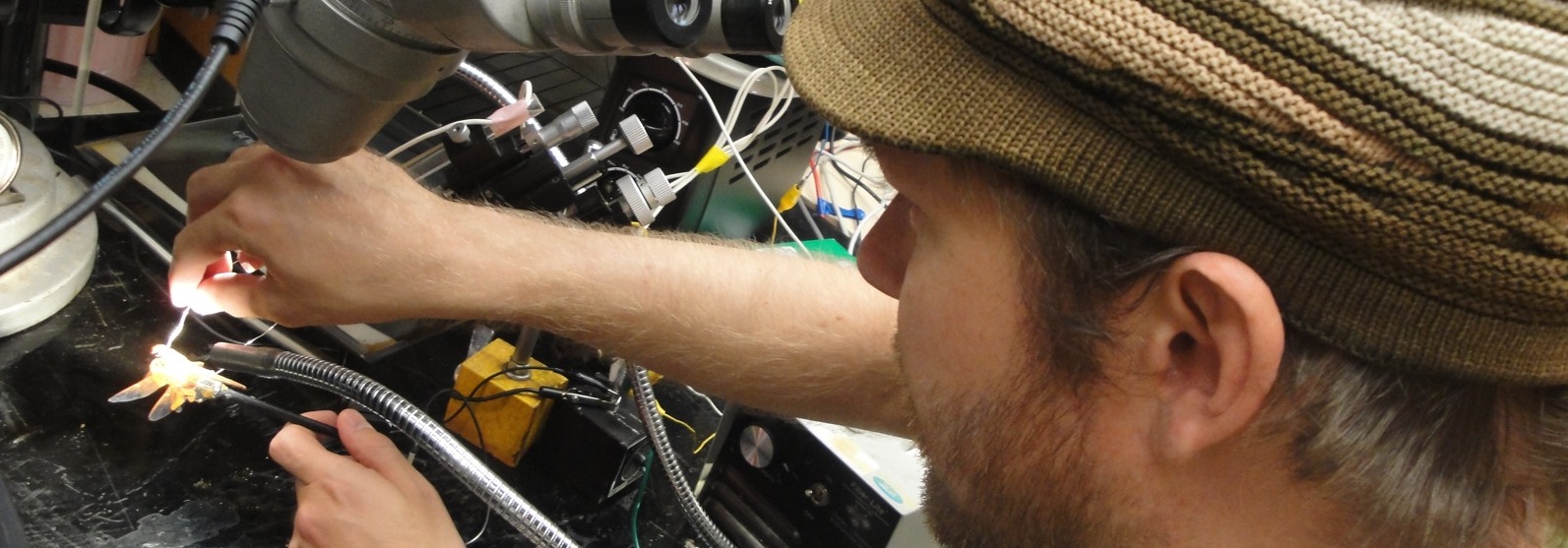
Dr. Higgins' work has garnered extensive media coverage, including television, radio, and newspaper features worldwide. A landmark demonstration — a robot guided by the live eyes and brain of a moth — captured international headlines and exemplified his lab's signature approach: harnessing biological intelligence to solve engineering problems.
University of Arizona · Tucson, AZ
Areas of Fascination
Where Ideas Take Flight